
Manufacturing processes don’t operate independently. The performance of one operation often determines the effectiveness of the next.
When evaluating textile finishing and processing equipment, selecting the right machine is only one part of the equation. Equally important is understanding how that equipment fits into the overall manufacturing process.
The substrate being processed, required product characteristics, production speed, available floor space, existing equipment, and operating conditions all influence the selection and configuration of a production line.
These factors are closely connected.
Fabric tension and width control can influence the uniformity of chemical application. The application method affects chemical distribution, wet pickup, and subsequent drying requirements. Drying and curing conditions, in turn, can influence dimensional stability, product performance, and production efficiency.
An improvement in one stage of production must be evaluated in the context of the entire process.
For tubular knit fabrics, operations such as detwisting, spreading, extraction, chemical application, drying, and compaction must work together to achieve the desired finished-fabric characteristics.
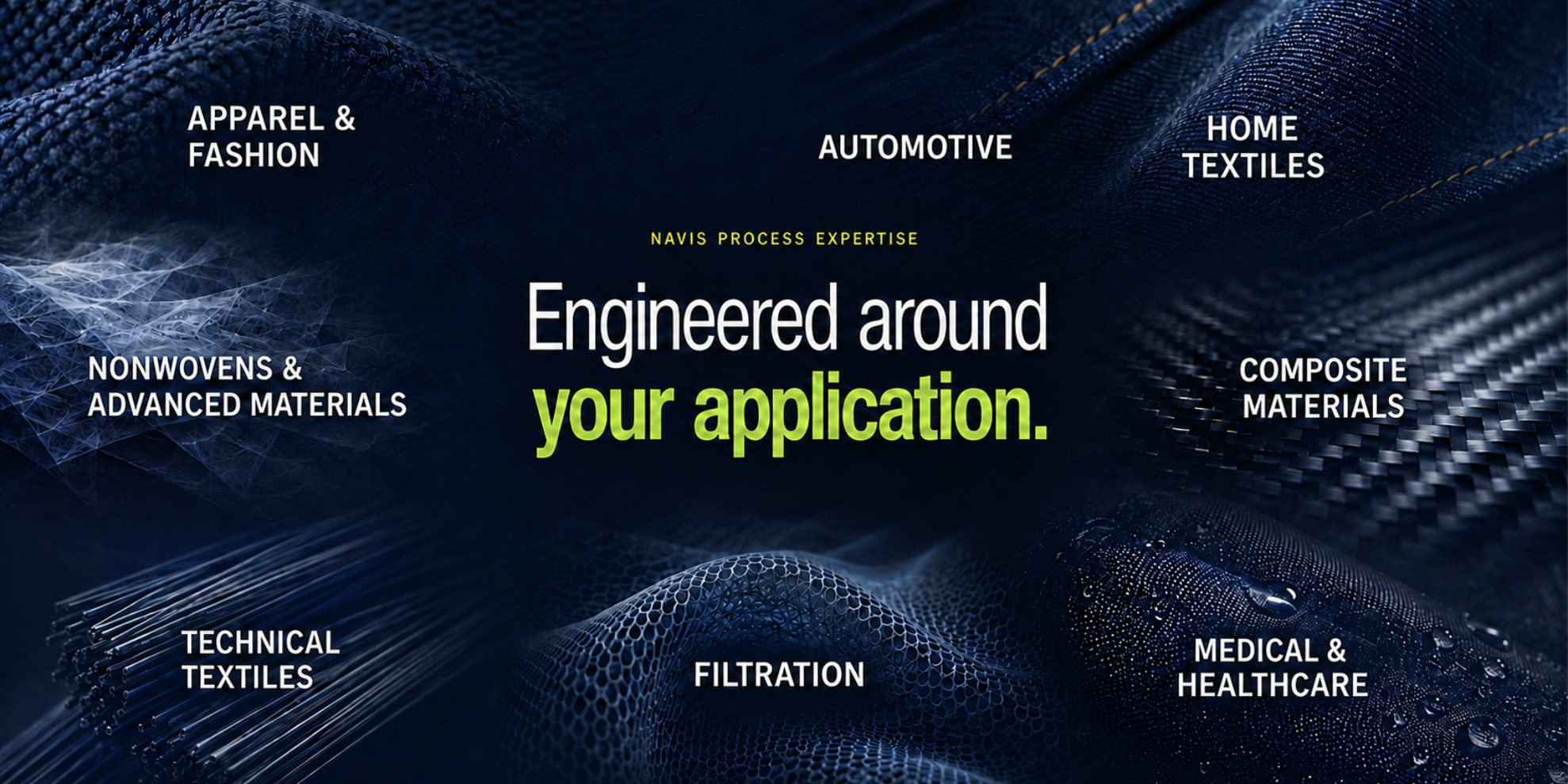
Open-width fabrics, technical textiles, and nonwovens present different processing considerations, including web handling, tension control, dimensional stability, coating uniformity, and thermal treatment.
Chemical application technologies introduce another set of variables. Foam application, rotary spray, and dry impregnation each offer different approaches to introducing chemistry into or onto a substrate. The most appropriate method depends on the material, chemistry, required functionality, and processing conditions.
The same systems-level thinking applies to continuous washing, bleaching, drying, and mechanical finishing.
At Navis TubeTex, our capabilities have evolved through engineering development, acquisitions, and technology partnerships to encompass more stages of textile and industrial processing.
This broader range of technologies allows us to consider manufacturing challenges from multiple process perspectives, whether the requirement involves a single operation, an upgrade to an existing line, or the development of a more integrated production process.
Understanding how these operations interact is an important part of determining the most appropriate equipment configuration and operating conditions.
Ultimately, effective process engineering involves balancing product quality, production capacity, operating efficiency, resource consumption, and the practical requirements of day-to-day manufacturing.
The goal is not simply to optimize individual machines, but to understand and improve the process as a whole.
Over the coming weeks, we’ll explore individual processing technologies, their operating principles, and the engineering considerations that influence their application across textiles, technical textiles, nonwovens, and other industrial materials.
Next in the series: Foam, spray, and dry impregnation—understanding the differences in chemical application technologies.